


Last updated: November 6, 2026. This one is a living article, so check back on it whenever a new Muse name pops up... I keep it current as things roll out, because they keep rolling out.
If you use Muse, or you're starting to, you have probably noticed the names multiplying. Muse Spark. Muse Wonder. Wonder Full. Glimmer. Somebody tells you your Meta Ray-Ban glasses are running on Muse Spark, somebody else says Muse is coming to the glasses, and a third person swears their subscription means they're on Wonder. The terms get used interchangeably everywhere, including by people who sound very sure of themselves, and that is where most of the confusion is coming from. So here is the whole landscape laid out in one place, in plain language, because this space is evolving fast and it is a lot easier to follow along when the names actually make sense.
One piece of routing before we start, so you get what you need out of this. If you have landed here and you are still at the stage of figuring out what Muse itself is, go and read my What Is Meta Muse article first, it starts right at the beginning and walks through what the agent does and how you set it up. This article is the next layer down. It is for people who are using Muse, or listening to conversations about it, and keep bumping into the model names underneath it. Right, let's map it out.
Meta AI and Muse: two products, a three-year head start, and one name doing too many jobs
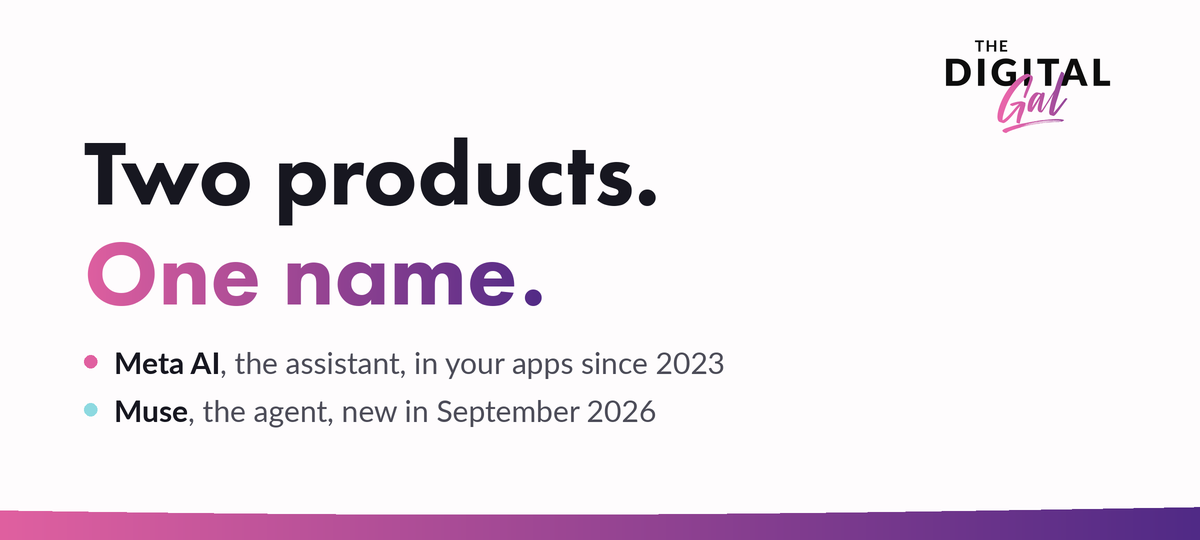
There are two different products in these conversations, and they have been in people's hands for very different lengths of time.
The older one is Meta AI, the assistant. Meta put it in front of the public in the fall of 2023, inside WhatsApp, Messenger, and Instagram, and on the Meta Ray-Ban glasses and the Quest headsets. It is the one you ask a quick question, the one that answers out loud on your glasses. It has been part of people's phones for a little over three years now, which in AI terms makes it the established furniture.
The new one is Muse, the agent, and it only launched on September 8, 2026, so it has been in consumer hands for about two months as I write this. Muse is the one you hand a job to... research this, build that, book the thing, follow up on the other thing... and it goes and does the steps. I use it in my business every day, and most of what I write about on this site is Muse the agent.
And then, just to keep everyone on their toes, Muse is also the name of the family of AI models underneath both products, built by Meta's lab, Meta Superintelligence Labs. Spark, Wonder, Glimmer, those are all Muse models. So one word is doing three jobs: a model family, an agent product, and a prefix on every model in the family. Once you hold that still, the rest of this article is just filling in the boxes.
Models, engines, and Llama: the ground floor
A quick ground floor, because everything else sits on it. When people in AI say a "model," they mean the brain itself, the trained system that reads what you give it and produces the answer. The products, the apps and the glasses and the websites, are what you touch. The model is what is doing the thinking inside them. The car analogy is the one that holds up best here: the product is the vehicle, the model is the engine under the hood, and the same engine can be put into more than one vehicle, which is exactly what Meta has done, as you'll see in a minute.
You will also hear "LLM" thrown around, it stands for large language model, and all it means is a model trained on enormous amounts of text and other material so that it can understand language and generate it. Every name in this article is an LLM of one size or another.
And Llama, because it keeps coming up in this story: Llama was Meta's previous family of models, the ones Meta AI originally ran on when it launched in 2023. Llama was also famous for a second reason, Meta gave the models away to outside builders to download and build on, which almost nobody else at that scale was doing. Keep that giveaway tradition in mind, it comes back later in this story wearing a new name.
Muse Spark: the everyday engine
Muse Spark is the base engine of the new family, the first model out of Meta Superintelligence Labs, launched April 8, 2026. It has been updated in versions since, 1.0 in April, 1.1 in July, 1.2 in August, and 1.3 on September 2, and when the Muse agent launched in September, Spark is what it ran on.
When I call Spark the everyday engine, here is what that means in plain terms. An everyday engine is built to run all day, every day, for millions of people at once, answering fast and not costing a fortune every time it turns over. That is Spark's job in the lineup. It powers the Muse agent, and earlier this year it took over a second vehicle as well: Meta completely rebuilt Meta AI on Muse Spark in mid-2026, retiring the Llama-based setup it had run on since 2023. Meta's own wording was that Spark "powers the completely rebuilt Meta AI," and the newest Meta glasses line launched with, in their words, "Meta AI powered by Muse Spark from day one in the US and Canada." So when somebody says your glasses run on Muse Spark, they are right about the engine. The assistant you are talking to on those glasses is still Meta AI. Engine, Spark. Vehicle, Meta AI. Two names, both true, talking about different layers.
Muse Wonder and Wonder Full: the frontier models
Wonder is the other end of the family, and "frontier model" is the phrase that needs translating here. A frontier model is the one out at the edge of what is currently possible, the most capable, the most powerful, and the most expensive to run. Every car company has the everyday engine in everything on the lot, and then there is the race engine, built in small numbers, run carefully, not something you put in a commuter car. Wonder is Meta's race engine.
Meta launched Muse Wonder and Muse Wonder Full on October 12, 2026, describing them as frontier models for agents and saying they were built on the groundwork laid with Spark. Where do regular people meet Wonder? Mostly, so far, we don't, not directly. Wonder is available to builders through the Meta Model API and inside Muse Code, both of which get their own section below. Wonder Full is the fuller version of the two and it is reserved for Muse Code subscribers, it is not on the API at all. For those of us in the Muse app, Meta's announcement said Wonder "will soon power more of Muse, rolling out first to subscribers." Rolling out is the honest status. Meta has not given app users any way to check which model answered a given task, so anyone telling you their Muse is definitely on Wonder today is repeating announcement language, not reporting a fact about their account.
The coding side: Muse Code and the Meta Model API
A good chunk of the Muse talk online is actually coding talk, and it sounds like a foreign language if nobody translates it, so let's do that. Muse Code is Meta's product for people who build software. If the Muse app is the car you drive, Muse Code is the workshop, the place where builders work with the engines directly, take them apart, and put them into things of their own. If you do not write code, Muse Code is a name you can safely nod at and walk past, it is not a part of Muse you are missing out on.
The Meta Model API is the other door builders use, and "API" is worth thirty seconds because it sounds more mysterious than it is. An API is a service window. A restaurant with a service window does not let you into the kitchen, you order at the window and the food comes out. An API lets another company's software order work from a model, answers, summaries, agent steps, without ever touching the model itself. When you read that Muse Wonder is "available via the API," that is all it means: builders can order Wonder through the window and put it to work inside their own products.
Two details worth pinning down while we're here. The first is which engines sit behind which door: Wonder is behind both doors, the API and Muse Code, and Wonder Full is behind the Muse Code subscription door only. The second is a trap for the unwary... Muse Code has its own subscription plans, and its plan names overlap with the Muse app's plan names, Power and Maximum show up in both places meaning different things. If you ever find yourself comparing Muse pricing and the numbers refuse to line up, there is a decent chance you are looking at the workshop's price list while thinking about the car.
The open ones: Muse Glimmer and Muse Spark Open
Now the Llama giveaway tradition, back in Muse clothing. Two of the Muse models are open-weight, and that term just means Meta publishes the model itself for anyone to download. Spark and Wonder work the other way, you can only reach them through Meta's own doors, the app, the API, Muse Code. An open-weight model is the engine shipped out in a crate with the manual, a builder can install it in their own machine and run it themselves, no window, no subscription to Meta required for the model itself.
Muse Glimmer is the smaller of the two, released August 10, 2026. Glimmer was distilled from Muse Spark, and "distilled" is a lovely plain idea once somebody says it out loud: a big model teaches a smaller one, the way a master craftsperson trains an apprentice, so the small one carries as much of the skill as possible in a much smaller package. Glimmer is built to run agent-style jobs, multi-step tasks, using tools, on a person's own computer, a single good graphics card or a Mac, no data centre involved. It came out under the Apache 2.0 licence, which is about as permissive as these licences get, builders can use it commercially, change it, build products on it. Who is Glimmer for? Tinkerers and builders who want an agent brain running on their own hardware. It is a model in a crate, not a finished assistant, out of the box it has no browser, no logins, no memory of yesterday. But when you see Glimmer talked about as a big deal in builder circles, the local, downloadable, genuinely open part is why.
Muse Spark Open is the bigger sibling, released October 15, 2026, and it is exactly what the name says: the open-weight version of Muse Spark itself. Two differences from Glimmer worth knowing. It is very large, far beyond what a home computer runs, so "open" here mostly matters to companies and serious builders with real hardware. And it travels under Meta's own Muse Model License, which has conditions attached, rather than Glimmer's wide-open Apache terms. With one little caveat that applies to both of these: Meta has not said that either open model is the one running your Muse app. Your Muse runs on Muse Spark, the hosted one. The open pair are the family's engines let out into the wild, which is a story about builders, not a change to the product on your phone.
The voice names: Realtime Voice and Realtime Avatar
Quickest section in the article. When you hear Muse Realtime Voice and Muse Realtime Avatar, those are the models behind the voice conversations that started rolling out in the Muse app in the US this week, the ones where Muse talks back in real time and can appear as an avatar on screen if you want it to. Same family, specialised for talking instead of typing. If a new name has "Realtime" in it, it belongs to the voice side of the house.
So what is running on my Meta Ray-Ban glasses?
Pulling the glasses thread together, because this is where the interchangeable-names problem shows up most. The assistant on the Meta Ray-Ban glasses is Meta AI, powered by Muse Spark, and the same is true across the Oakley Meta glasses line. Meta's glasses release notes list Spark for both. A regular pair of Ray-Bans, to be clear, has no computer in it at all, it is specifically the Meta Ray-Ban glasses that carry the assistant, and the engine swap is why the assistant on a current pair feels sharper than the Llama-based version on the earlier ones.
Muse the agent coming to the glasses is a separate, unfinished story. Mark Zuckerberg said on Meta's earnings call on October 21 that "Muse is coming to Meta Glasses starting next month," and what has actually arrived is a beta. Meta's help centre has a page, "How to use Muse on your AI glasses (Beta)," that walks through switching your glasses' assistant over to Muse in the Meta AI app settings. With one little caveat, well, two. In the beta you pick one assistant, Muse or Meta AI, you do not get both at once, and the Muse beta cannot do some everyday glasses things yet, music, calls and messages, and navigation are on the not-yet list. And the reporting around the beta describes it as US-limited, so whether it is open to those of us in Canada has not been confirmed by Meta, and there is no published launch date for the full release. November is when the beta chapter started, not a date to circle for the finished thing.

The subscription tiers do not tell you which model you are on
Last box on the map, because it comes up in nearly every Muse conversation I have. The Muse app has tiers, a free level, Power at $20 a month, and Maximum at $100 a month, and what those tiers buy is usage, a bigger weekly allowance to spend. Meta does not publish a mapping from tier to model. There is no Meta page that says Maximum equals Wonder or Power equals Spark, I have looked carefully, because it would be a very handy thing to be able to tell people. The only model statement Meta has made about subscribers is the October one, Wonder rolling out to subscribers first, and rolling out is all it says. So choose a tier based on how much you actually use Muse, which is a question with a real answer, and not on a model name somebody attached to it in a post somewhere.
New names will keep arriving, the family is six models deep inside its first year and Meta is clearly not done, and this article will keep changing along with it, that is why the date sits at the top. It is the same habit as my Muse Updates Ledger, where I track what changed in Muse and when it changed. The sorting habit is the part that stays useful no matter what gets announced next: when a new Muse name lands in front of you, ask whether it is a model or a product, and if it is a model, ask which product it is sitting inside and which door you would even reach it through. That handful of questions has sorted every announcement since September, and it will sort the next one too.
 Facebook
 LinkedIn