

Originally published February 2022. Fully updated October 2026, because Meta has moved almost everything in this post since it first went up.
Do you get tangled up in the different ways you can give someone access to your Facebook Page, or take it away again? It is not just you. When I first wrote this post, Meta was partway through rolling out Business Suite and most of us were stuck living between two systems at once. I used the analogy back then that Meta was renovating their house room by room, moving functions out of the old house, Business Manager, and into the new one, Business Suite, as each room was finished.
Well, the renovation is done. Business Suite is the house now, and you will still hear the words Business Manager floating around, but what Meta mostly calls it these days is your business portfolio, and everything in this updated post lives in that one place. The confusing part is that some of the old furniture got replaced along the way, and the biggest casualty is Page Roles. If you have gone looking for Page Roles lately and could not find them, you are not losing it, they are gone. What replaced them, Page access, is getting harder to find, too. Meta has not announced that it is being retired, and I am not going to claim that with clarity when they have not, but plenty of Page owners have noticed the feature is simply no longer available on their Pages. So the third method below is the old way, kept in this post so the change makes sense and so you can still recognise it on the Pages that have it. The method that matters now is the first one, through your business portfolio.
TL;DR
Short on time? Here is the whole post in one breath. Access to your Page almost always lives in your business portfolio now, not on the Page itself. To add someone, go to business.facebook.com, open Settings, then Users, then People, and choose Invite people. Give them partial access, and assign only the assets they actually need... your Page, your ad account, your Instagram account. Full control is for business partners and people you trust like family, almost nobody else needs it. To remove someone, go back to that same People list, click their name, and choose Remove. And if they still have access after that, it is living somewhere else: a partner connection under Users, then Partners, the team list inside a third party tool like Agorapulse, or old-style Page access on the Page itself, under Page setup in your Page's settings. Four separate doors, and each one has to be closed on its own. The rest of this post walks through every door slowly, with the safety notes included.
Here are the puzzle pieces we will cover:
- Personal Profile vs Business Page
- Page access, the old way, which replaced Page Roles and is disappearing from a lot of Pages
- Business Suite and your business portfolio
- How to add and remove people
- Partial access vs full control
- What to do if another business account owns your Page
Before we go digging around in permissions, it helps to know the difference between Profiles and Pages. Then I will show you the three ways people give access to a Page: the way that matters now, through your business portfolio, then through a third party app, and last, the old way, right on the Page itself.
Personal Profile vs Business Page
There is a big difference between your personal profile and your Business Page, and you need a personal profile first before you can create a Page at all.
Your personal profile represents you, authentically. People request to become friends with you, and you choose who you become friends with.
Think of your Business Page like a billboard. Anything you post as your Page is public and anyone can follow it. You can invite other people to help you manage it, and you can give them different levels of access depending on how they are helping you.
Each Business Page is attached to real people's personal profiles. The general public cannot see who runs a Page, although through Page Transparency they can see when the Page was created and the country the people managing it are in.
Never give anyone your login information for your personal profile.
Keep that to yourself. Nobody needs your login details to get access to your Page, every method in this post exists so you never have to share them, and the consequences of handing over your login far outweigh any shortcut it feels like in the moment. Your profile is the key to everything attached to it, your Page included, so it stays yours.
I wrote a whole post on this one, Why You Should NEVER Have A Second Facebook Profile Or Login To Someone Else's, because the workarounds people reach for, keeping a second profile, logging in as someone else, cause exactly the kind of account trouble that takes weeks to untangle.
When you post to a Page you manage, you will see a small notation saying who created the post. The general public cannot see that, only people who have access to the Page can, so your privacy as the person behind the Page is protected as long as you are working through your own authentic profile.
Business Suite and your business portfolio
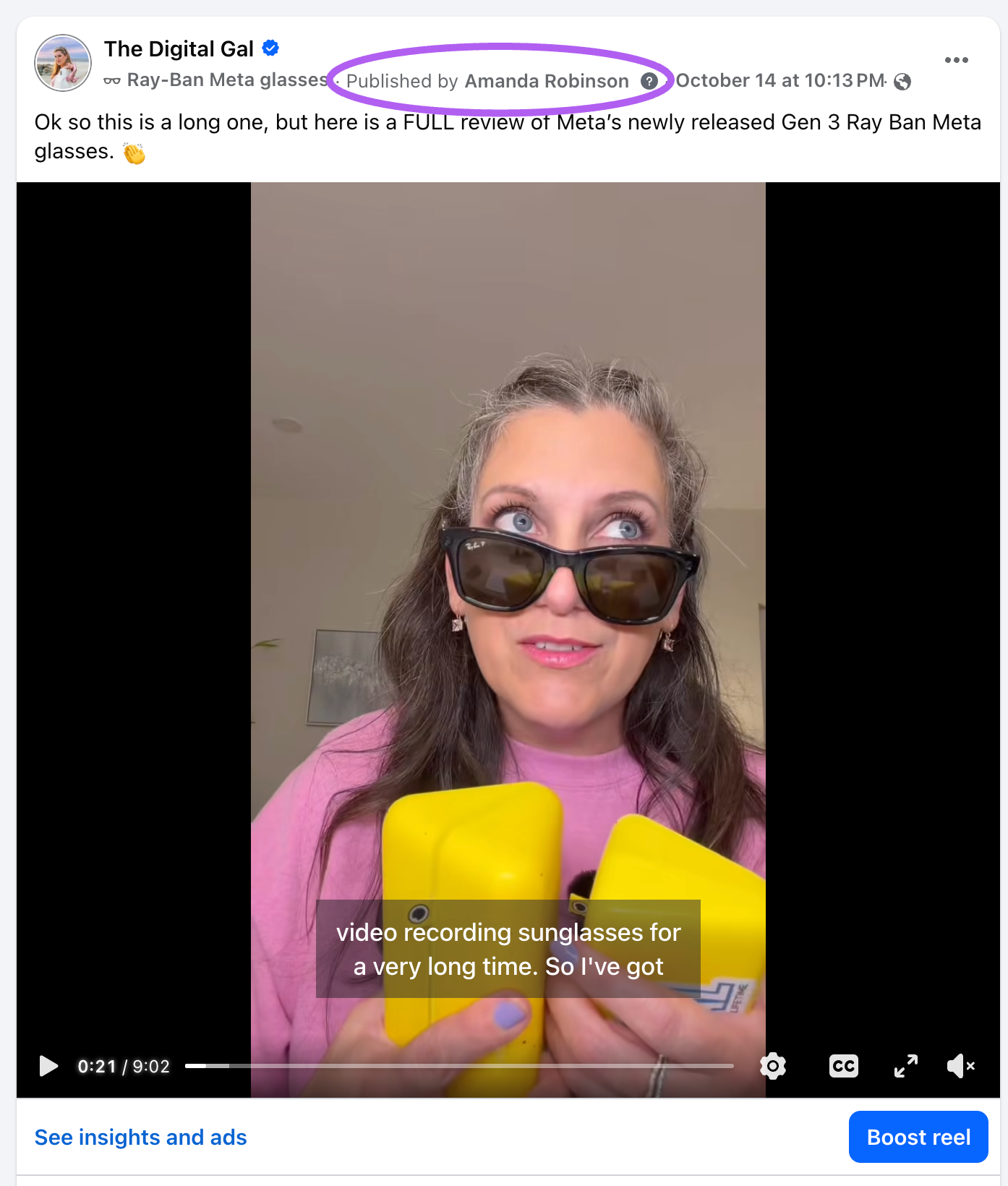
Meta Business Suite is the hub where you manage your business across Facebook and Instagram, posting, messages, insights and ads all in one spot, and you get to it at business.facebook.com. Underneath it sits your business portfolio, which is the container that actually holds your business assets, your Pages, ad accounts, Instagram accounts, datasets and catalogues, along with the people and partners who have access to them.
You will still see older names for this in menus and in other people's tutorials. Business Manager was the old name, business account and business portfolio mean the same container now, and Business Settings is simply the settings area where all of the people and permissions in this post are managed. If a tutorial tells you to open Business Settings, you are headed to the right neighbourhood no matter which name your screen uses.
There are three ways you can give other people access to your Business Page
1) Through Business Settings in your business portfolio
This is the method I recommend for most businesses, and it is the preferred method if you plan on running ads.
When your Page lives inside your business portfolio, giving access through Business Settings means the person's access is managed in one central place, across all of your assets at once. If they leave, you remove them from the portfolio once and everything they could reach through it goes away with them, instead of you hunting asset by asset. You do not need to be Facebook friends with them for this either, the invitation goes to their email address.
It is a two part process, add the person to your portfolio, then assign them the assets they need.
Part one, add the person:
- Go to business.facebook.com and open Settings, then make sure you are looking at the right business portfolio if you have access to more than one.
- Under Users in the left menu, click People, then click Invite people.
- Enter the person's work email address and click Next.
- Choose their access to the portfolio itself. Partial access is the default, and it means they can only work on the specific assets you assign them. Full control means they can manage people and settings across the whole portfolio, and we will talk about that choice in a moment. There are also finance roles tucked under the advanced options if you ever need someone to see billing without touching anything else.
- Click Next and move on to assigning assets.
Part two, assign the assets:
- Pick the assets this person actually needs. The list you will work through can include your Facebook Page, your ad account, your Instagram account, your dataset (that is what the pixel grew up into, the tracking piece now lives inside a dataset), and your catalogue, if you have one.
- For each asset, choose what they are allowed to do with it, whether that is specific tasks like creating content or running ads, or full control of that one asset.
- Review the invitation and send it. They will get an email invitation and they have to accept it before anything works, and nothing is live until they do.
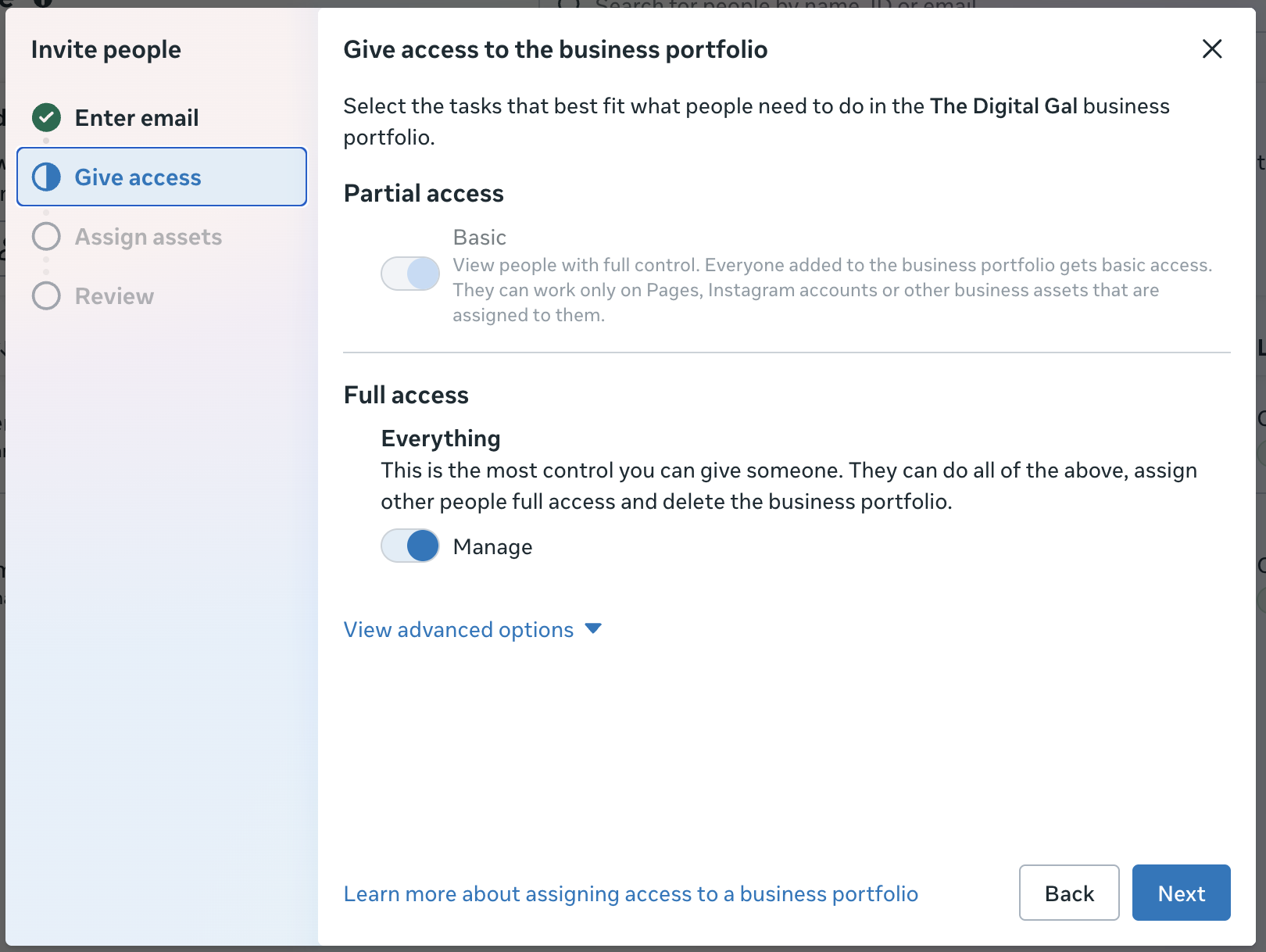
A word about full control, with love
Here is the safety tip from the original version of this post, translated into the new language, because it is the most important paragraph in the whole article. Do not hand out full control of your business portfolio to anyone who is not a legitimate business partner or owner, or someone you trust the way you would trust a spouse or a close family member. A person with full control can add and remove people, change settings, and potentially remove you from your own business portfolio, and untangling that is a miserable afternoon you do not need.
For almost everybody else, partial access plus carefully assigned assets is plenty. Your bookkeeper does not need full control to see billing, your ads person does not need full control to run ads, and your content help does not need it to schedule posts. They cannot take your business portfolio, and they cannot kick you off your own Page, and if the working relationship ends, removing them from the portfolio removes everything in one step.
Working with an agency or a contractor? Add them as a Partner
If you are a service provider being added to a client's account, or you are the business hiring one, there is a cleaner route than adding individual people. Businesses can share assets with each other directly, portfolio to portfolio, using the Partners section.
If you are the client giving access, your provider needs their own business portfolio, and they need to give you their Business ID, which they can find in their own settings under Business portfolio info. Then:
- In your Business Settings, under Users, click Partners, then Add.
- Choose Give a partner access to your assets.
- Enter their Business ID and click Next, and check that the business name Meta shows you is actually theirs.
- Assign the assets they need, your Page, ad account, Instagram account, dataset, catalogue, with the permissions their work requires.
- Save, and they will get the request on their side to accept, after which they can assign those assets to their own team members inside their own portfolio.
This is the setup I point clients toward, because the access belongs to the business rather than to whichever individual happens to be your account manager this year. When their team changes, your access list does not have to.
If you are the provider being asked for access instead, the same Partners screen has the mirror option, Ask a partner to share their assets, which sends the request in the other direction.
2) Through a third party tool like Agorapulse
The second way skips Meta's settings almost entirely. Social media management tools like Agorapulse let you add team members inside the tool itself, and those people connect with their own profiles and work on your accounts through the app, without ever being handed your login and without you digging through Business Settings for every helper.
Agorapulse is the example I use, because it is the one in my own stack, and I am an Agorapulse Ambassador. You add a team member to your organisation in the tool, connect the social accounts once, and assign who can work on which account. Someone can draft and schedule content for Facebook and Instagram, Stories and Reels included, and the content can be sent to the account owner's phone for final publishing where a platform requires it. When a team member moves on, you remove them from the tool's team list and their access through the app ends there, although keep in mind that if that same person was also given access directly in Meta at some point, that separate access still needs removing separately, which brings us to the next section.
3) Through Page access, right on the Page (the old way)
This is the method that replaced Page Roles, and if your memory of adding people to a Page involves a little dropdown list of roles like Admin, Editor and Moderator, this section is your translator, because that dropdown is retired.
It is also, now, the old way. Meta has not announced that Page access is being retired, so I will not say that with clarity when they have not. What I can say is that a lot of Page owners have noticed this feature is no longer available on their Pages: the Page access screen is not where it used to be, or the option to add someone new does not work. The most common reason is that the Page lives inside a business portfolio, and when it does, Meta manages access through Business Settings rather than on the Page itself. I am keeping this section in the post for two reasons: some Pages still have it, and a lot of the access floating around out there was given this way, so you need to recognise it when you are cleaning up. But if you go looking for it on your Page and cannot find it, you are not doing anything wrong. Head back up to method one. The business portfolio is where access lives now, and it is the way to give someone access to your Page without using these older Page-level permissions at all.
Where Page access still exists, it has two flavours, and choosing between them is the main decision.
Facebook access means the person can switch into your Page and work on it directly on Facebook, much the way you do. When you give someone Facebook access, you will see a toggle that asks whether to allow them full control. Full control is the big one. A person with full control can manage Page settings, give access to other people, remove people, including you, and even delete the Page. With that toggle left off, their Facebook access is partial, and they can do the day to day work on the Page without holding the keys to the whole thing.
Task access means the person never switches into your Page at all. Instead, they work through tools like Meta Business Suite and Ads Manager, and only on the specific tasks you hand them. You pick from tasks like content, messages, ads and insights, and they get exactly those and nothing more. Task access is a lovely fit for most helpers, things like a social media manager who only posts content, or an ads person who only needs the ads task.
Roughly translated from the old roles, full control is what Admin used to be, and Editor, Moderator, Advertiser and Analyst have mostly become task access with the content, messages, ads and insights tasks switched on to match the job. It is not a perfect one to one swap, so check the task list against what the person actually does rather than assuming the old title carried over.
To add someone this way, you need full control of the Page yourself, and then:
- Switch into your Page, so you are acting as the Page and not as your personal profile.
- Click your Page's profile picture in the top right, then Settings & privacy, then Settings.
- In the left menu, click Page setup, then Page access.
- Next to People with Facebook access or People with task access, click Add New, then Next.
- Search for the person by name or by the email address connected to their Facebook account, and select them.
- If you are giving Facebook access, decide on that full control toggle, and if you are giving task access, switch on the tasks they need.
- Click Give access, and enter your Facebook password when Meta asks you to confirm it is really you.
- The person gets a notification and has to accept before their access works, and until they accept you will see them sitting in your list as pending.
One more that catches people during handovers: if you were only just given full control yourself, Meta can hold you in a security window of around 7 days before you can pass access on to anyone else. It is not you doing something wrong, it is a waiting period, and it lifts on its own.
One change that trips people up is that you no longer have to be Facebook friends with the person first, the way the old Page Roles flow wanted. If they do not show up in your search, the usual culprits are a misspelled email, an email that is not the one attached to their Facebook account, or their profile privacy settings keeping them out of search results.
Removing a person from your Business Page
I hear from people about removal far more than about adding. Usually someone is changing agencies, bringing their ads in house, or parting ways with a contractor, and they cannot figure out why the person still has access after they removed them from the one place they remembered.
The first step is figuring out where that person's access actually lives. Access given through your business portfolio, through a partner connection, through a third party app, and through Page access are four separate doors, and removing someone from one door does nothing to the other three. They need to be removed from each place they were ever given access.
Remove them from your business portfolio
- Go to business.facebook.com, open Settings, and under Users click People.
- Click the person's name, then click Remove, and confirm.
- This removes them from the portfolio entirely, which takes away every asset they were assigned through it in one move.
If they only need to lose one asset and keep the rest, use the Manage option beside that specific asset on their profile instead, and adjust just that one.
Remove a partner business
In Business Settings, under Users, click Partners, find the business in the list, and remove them. That ends their portfolio's access to every asset you shared with them, and their whole team loses it at once, which is one more advantage of sharing business to business in the first place.
Remove them from your third party app
Inside the tool, go to your organisation or team settings, find the team member, and remove them. In Agorapulse that is your organisation settings, then your team list, remove. Then double check the other three doors in this section, because app access and Meta access are separate things.
Remove them from Page access
This door only applies if their access was given the old way, through Page access. If your Page no longer shows a Page access screen, their access does not live here, and one of the other doors above is the one to close.
- Switch into your Page, then go to Settings & privacy, then Settings.
- Click Page setup, then Page access.
- Find the person in the Facebook access or task access list, click the three dots beside their name, and choose Remove access.
- Confirm with your password if Meta asks.
If your Page is owned by another business account
This is the rescue section from the original post, and it stays because I still see this exact situation regularly. You are an admin on your Page, you try to clean up access, and you keep hitting errors or a wall. Often the reason is that your Page is owned by a business portfolio that is not yours. Sometimes an employee set the business account up years ago and the Page is still sitting in theirs, or an old agency claimed it, and when that person or relationship went away, your Page stayed tied up in a portfolio you cannot get into.
A Page can only be owned by one business portfolio, and only someone with full control of that owning portfolio can release it. There is no button on the Page side that overrides that, as frustrating as that is to hear. The fix has to happen inside the portfolio that owns it, so you will need to reach out to whoever runs that portfolio, a former employee, a previous agency, and ask them to do this:
- Go to business.facebook.com and open Settings for the portfolio that owns the Page.
- Under Accounts in the left menu, click Pages.
- Select your Page from the list.
- Click Remove, and confirm that they want to remove the Page from that business portfolio.
Removing a Page from a portfolio does not delete the Page, it just releases it, and once it is released your own portfolio can claim it properly, which is where it should have lived all along.
One wrinkle from the original post that is still worth knowing: if that Page is set as the primary Page of their business portfolio, Meta may not let them remove it until they pick a different primary Page first, which they can change in their Business portfolio info. If they tell you the remove button will not cooperate, that is the first thing to check.
Once your Page is home in your own portfolio, do yourself a favour and make sure at least two people you trust have full control of it, so the business is never one departed employee away from this situation again.
Want this whole topic walked through in one place?
If this post has you wanting the slower version, with the screenshots and the why behind each setting, this is one of the things we cover in detail in Instagram & Facebook All-in-One For Dummies, the book I co-wrote. Page access, business portfolios, partners, adding and removing people, it is all in there step by step, alongside the rest of setting up Facebook and Instagram properly for a business. This post will get today's job done, and the book is the full map for the days you want it beside you.
A last thought before you go clicking
Access is one of those unglamorous corners of running a business on Meta that only gets attention when something goes wrong, and a ten minute look through your Page access list and your People list a couple of times a year will save you from almost every story in this post. When was the last time you looked at yours, and did you find anyone on the list you did not expect to see?
 Facebook
 LinkedIn